• Skip to primary navigation
  • Skip to main content
  • Skip to footer
ElevateBio

ElevateBio

Powering the creation of cell & gene therapies at a speed the world deserves.

  • Resources
    • Resources Overview
    • Elevated Insights
    • Presentations & Publications
    • Whitepapers
  • Media
    • Media Overview
    • Press Releases
    • Featured News
  • Facilities
  • Careers
  • Contact
  • Search
  • Manufacturing & Discovery Services
    • Manufacturing & Discovery Services Overview
    • Gene Editing Design & Optimization
    • Process Development
    • Analytical Development
    • cGMP Manufacturing
    • Next-Generation Sequencing
    • Quality
    • Regulatory CMC
    • Certifications & Compliance
    • Generative AI
  • Technologies
    • Technologies Overview
    • Gene Editing
    • Viral and Non-Viral Delivery
    • Messenger RNA (mRNA)
    • Induced Pluripotent Stem Cells (iPSCs)
  • Advanced Therapies
  • Partner With Us
  • About
    • About Overview
    • Our Journey
    • Our Team
    • Culture of Expedition
    • Careers
  • Media
    • Investors & Media Overview
    • Press Releases
    • Presentations & Publications
    • Elevated Insights
  • Careers
  • Facilities
  • Contact
  • Manufacturing & Discovery Services

    Manufacturing & Discovery Services Overview

    Capabilities & Services
    • Gene Editing Design & Optimization
    • Process Development
    • Analytical Development
    • cGMP Manufacturing
    • Next-Generation Sequencing
    Expertise
    • Quality
    • Regulatory CMC
    • Certifications & Compliance
    • Generative AI
  • Technologies
    • Technologies Overview
    • Gene Editing
    • Viral and Non-Viral Delivery
    • Messenger RNA (mRNA)
    • Induced Pluripotent Stem Cells (iPSCs)
  • Advanced Therapies
  • Partner With Us
  • About
    • About Overview
    • Our Journey
    • Our Team
    • Culture of Expedition
    • Careers
    • Investors

Analytics & NGS

November 26, 2025 by

Over the past decade, our industry has witnessed the scientific promise of cell and gene therapies. Patients with rare diseases or hard-to-treat diagnoses now have new treatment options harnessing human cells and genes to alter disease. But the accessibility of these therapies the industry has developed remains constrained not by what’s biologically possible, but how they are designed and manufactured.

The field has reached an inflection point. We’ve demonstrated the scientific foundation and its curative potential. But to make advanced therapies sustainable as a pillar of medicine, we must make them more accessible. The companies that will define cell and gene therapy’s future will be those who can eliminate the distance between top science and efficient manufacturing.

Integration of Manufacturing and Therapeutic Design

Traditional small molecule drug development has very siloed development pathways: a therapeutic is designed and developed by one team and then manufactured by another. This approach is challenging in cell and gene therapy, often leading to delays, setbacks, or even outright failures. We built ElevateBio to solve this problem with a new approach, one in which therapeutic design and manufacturing operate as an integrated ecosystem.  

ElevateBio BaseCamp, our cGMP manufacturing business, goes beyond a traditional CDMO. We bring together expertise, advanced technologies, and state-of-the-art facilities to serve as a skilled partner to biopharmaceutical companies. This includes in-house manufacturing, process and analytical development, and quality control teams, all working in parallel to achieve tighter coordination and faster turnaround times. BaseCamp has industrialized genetic medicine manufacturing, achieving a 98% batch success rate across advanced programs.

Yet sustaining this success – and expanding it across new modalities – requires more than technical excellence alone.

Designing for Manufacturability from Day One

The future of cell and gene therapy depends on therapies designed with manufacturability in mind from the start – and into every stage of design. That’s why our team of process development scientists are embedded in design conversations early, creating commercial-ready processes in parallel with therapeutic development. Manufacturing insights flow back to inform molecular engineering in real time.

This includes integrating compact constructs and delivery systems engineered for both efficacy and efficiency. We apply scale-down and scale-up models to optimize performance, ensuring processes are fully scalable to GMP manufacturing and capable of meeting global demand.

We take the same approach through ElevateBio Life Edit, our gene editing technologies and R&D business. When our teams develop gene editors across all modalities, manufacturability is a design criterion from day one – not a constraint discovered in late-stage clinical trials. And by having BaseCamp and Life Edit sit alongside one another, we’re ensuring the latest manufacturing developments and insights flow back to inform R&D – and vice versa.

A Foundation for an Industry to Prosper

Looking beyond the science, what does a sustainable cell and gene therapy ecosystem require?

It’s more than better therapeutics. We need more treatment centers, expanding from dozens to hundreds for better patient access. The industry needs new commercial models that make advanced therapies economically viable for health systems. We need a whole new infrastructure where cell and gene therapy can become the standard of care for previously untreatable conditions.

But that infrastructure can’t be built upon unreliable manufacturing. We as an industry need to build a strong foundation – one built by designing, optimizing, and validating processes that reliably move therapies from bench to bedside. Without that foundation, the ecosystem simply can’t scale. And the window to build it is narrowing.

CAR-T is expanding into autoimmune indications with patient populations 10 times larger than oncology. In vivo therapies are advancing as new-generation modalities are adding layers of complexity. To support this growth, the field needs manufacturing designed for reliability and scale from day one.

Building What Comes Next

The field now needs the operational discipline and integrated thinking to deliver on that promise at population scale.

The therapies we’re developing today have the potential to transform millions of lives. But only if we build the systems to make them accessible, reliable, and sustainable.

At ElevateBio, we’re building that foundation by combining BaseCamp’s manufacturing platform with Life Edit’s R&D capabilities – and embedding therapeutic design expertise throughout. By doing so, we’ve created an integrated approach that’s building cell and gene therapy’s future and making a tangible impact for patients worldwide.

April 10, 2025 by

Our NGS services address key industry challenges, and benefit startups and smaller biotechs that may be unwilling or unable to afford the large capital investment required to set up their own NGS laboratories.

Next-generation sequencing (NGS) has accelerated scientific advances and the development of many new therapies by enabling automated sequencing of millions of DNA or RNA fragments rapidly and simultaneously. NGS is critical to the development of cell and gene therapies in multiple ways, from determining how process development parameters affect a cell therapy product, to identifying on- and off-target edits of a gene editing system.

ElevateBio recognizes the scientific and economic value of insourcing our NGS capabilities; considering factors such as analysis costs, turnaround times, data quality, and the needs of our partners, clients and R&D teams, which are best served by internal NGS services. Our NGS capabilities can be especially beneficial to startups and smaller biotechs, where making a meaningful capital investment to establish their own NGS laboratories and talent may be challenging.

Here, we discuss the capabilities of our NGS core, the unique advantages we offer to our clients, and our vision for the near future.

Addressing Industry Challenges with an Internal NGS Core 

ElevateBio’s NGS core includes both a wet lab and a dry lab, combining our NGS laboratory with informatics expertise to enable end-to-end automated sequencing workflows. The laboratory is equipped with sequencing technology platforms and the various materials and kits needed to prepare libraries of DNA or RNA fragments – for sequencing, as requested by our clients. The informatics portion of our group encompasses the computational infrastructure needed to rapidly process, analyze and extract meaningful insights from sequencing data.  

Our NGS core overcomes several industry challenges:

  • Turnaround Time: Our core offers turnaround times that are 2-4 weeks faster than external contract research organizations, which is especially meaningful for complex sequencing applications like RNA-seq and Whole Exome Sequencing that may require more time for data analyses.
  • Cost: We are continuously optimizing our methods and digital workflows to improve efficiencies and reduce costs.
  • Expertise: With decades of combined experience within the NGS team, we understand both the technical and biological aspects of sequencing. This expertise ensures we deliver high-quality, cost-effective data that help clients advance their projects in a meaningful way.
  • Collaboration: Our NGS team’s flexibility and collaborative approach are key benefits for our clients. We work closely together starting from designing experiments with the right controls in place to reviewing the data to ensure clarity.

Our Core Applications

ElevateBio’s NGS core can conduct a broad array of sequencing applications, including:

Amplicon sequencing for targeted regions of the genome

Whole genome sequencing (WGS)

Whole exome sequencing (WES)

RNA sequencing (RNA-seq), including single-cell RNA-seq

Methylation sequencing

What this means for our customers is access to answers more quickly, faster turnaround times and optimized costs. By continually making efficiency improvements and leveraging our decades of expertise, we can deliver high-quality, cost-effective data, driving meaningful project advancement for customers and their programs.

Evaluating and Optimizing Automated Sequencing Workflows and Technology for Maximum Efficiency

For each of our sequencing applications we’ve developed protocols and optimized the workflow for efficiency, rapid turnaround and high data quality. These optimizations involved side-by-side comparisons of library preparation kits in terms of price, data quality, ease of use and customer support to determine which kit was best for each of our applications. We constantly assess new technology additions to the market and perform comparative testing to identify opportunities to further improve turnaround time, pricing or overall performance.

Our team of experts took the same approach to the more recent launches of novel sequencing platforms: we compare new technologies on the market to our own and assess the potential advantages of upgrading our instrumentation. Staying at the forefront of technological advancements – by thoroughly vetting new innovations and anticipating our client’s needs – is crucial for delivering timely, high-quality data to our partners.

Likewise, we also optimized bioinformatic workflows researching available computational and software tools and performing side-by-side analyses for various applications. Recognizing the importance of streamlined data management early on, we identified the need to focus on our data infrastructure and automate the flow of information from the sequencers into our cloud infrastructure and other data structures – laying the groundwork for scalable automated sequencing. We have a specialized team member focused on meeting this demand as automation is critical for minimizing costs and improving turnaround times.

Next-Generation Sequencing Services are Designed to Support all Cell and Gene Therapy Modalities

Our NGS core supports all the sequencing needs of BaseCamp, our end-to-end process development and cGMP manufacturing business, and Life Edit, our gene editing and R&D technology business, as well as those of our clients.

For Life Edit and partners across the ElevateBio ecosystem, the core’s work has focused primarily on characterization of on- and off-target gene editing. Other projects supporting our internal R&D groups have included single-cell RNA-seq of T cells, to determine if changes in process parameters alter the phenotype of cells; and using RNA-seq, WES, and targeted methylation sequencing to assess whether differentiation protocols for induced pluripotent stem cells (iPSCs) had introduced potentially deleterious alterations to the final, differentiated cells.

We’re continuously innovating and expanding our capabilities to meet the additional needs of client companies. We’re exploring additional applications to help drive initiatives in cell and gene therapies, aiming to offer not only essential assays but also valuable characterization assays as well.

Our Successes Drive the Future of Cell and Gene Therapies

Several measures highlight the impressive progress ElevateBio’s NGS core has made.

  1. Faster Turnaround. One key success is the rapid implementation of more efficient automation and library preparation, which has significantly sped up turnaround times for our amplicon sequencing workflow. After testing several optimization strategies to streamline our process and enhance efficiency, we now consistently achieve a throughput of up to 5,000 amplicon libraries with a turnaround time of under 7 days (using Illumina NextSeq 1000/2000).
  2. Increased Multiplexing. Another success that we are particularly proud of is how we’ve increased our multiplexing capacity, or the number of individual libraries that can be sequenced in a single run. We’ve gone from 384 last year to 1,536 currently, with plans to reach 2,304 in the coming months (using Illumina NextSeq 1000/2000). This rapid increase was made possible by miniaturizing our reagents and reaction volumes by a factor of ten and incorporating customized indexes or “barcodes” to identify individual libraries in each multi-library run. Multiplexing reduces the cost of analysis per library, and thus increases the overall cost efficiency of our NGS core. 
  3. Higher Throughput. By optimizing processes and introducing workflow efficiencies, our throughput can now reach up to 18,000 libraries per month – and will continue to grow, ensuring we stay ahead of the increasing demand for our services.

With cutting-edge technology, expert knowledge, and a collaborative approach, our NGS core provides clients and partners the flexibility, customizability, rapid turnaround times, and high-quality data needed to drive the future of cell and gene therapies.

As we expand, automated sequencing will continue to be a cornerstone of our innovation—enabling greater efficiency, accuracy, and scalability for both current and future partners.

February 14, 2025 by

Cell therapies have emerged as a transformative tool of modern medicine, offering unprecedented potential to treat and cure a wide range of diseases. Engineered cell and gene therapies are able to address the etiologic genetic mutation or eradication of the disease-relevant cellular compartment, with profound improvements in clinical outcomes. From immune-based approaches like T cell therapy for cancer to regenerative applications utilizing stem cells, cell therapies are redefining the boundaries of treatment modalities. 

Gene delivery technologies enable the introduction, deletion, or modification of genetic material within cells, equipping them with novel therapeutic properties or optimizing their natural capabilities. From viral vectors such as lentiviruses and adenoviruses to non-viral methods like electroporation and lipid nanoparticles, these technologies form the backbone of genetic engineering in cell-based treatments. 

The quality control measures that underpin the development and commercialization of these promising therapeutics are key to furthering them within the larger biopharmaceutical pipeline. In particular, potency assays are central to this pursuit, as these analytics are crucial to ensuring product consistency, efficacy, and safety. The potency of a product is the specific ability or capacity of a product to achieve a defined biological effect. Potency assays are quantitative measures of biological activity and are typically assessed in vitro. 

In the case of CAR or TCR T cell products, both the vector to deliver the gene of interest (GOI) and the gene-modified T cell drug product require potency assays to be in place to support product release and stability. By adopting a phase-appropriate yet prospectively considered approach to potency development as early as possible in a process, organizations can arrive at a potency control strategy that improves the foundational understanding of a product’s quality and consistency and results in a strategy that will be suitable for a marketing application while not jeopardizing the use of valuable clinical data needed to support the safety and efficacy assessment for the application.

Genetic medicine potency assays

The development of potency assays can be challenging due to the complex nature of cell and gene therapies and the lack of standardized methods in the broader development space. Development of suitable and robust potency methods requires plenty of development data and correlation from orthogonal readouts. During early phases of drug development, a potency assay can be a quick and simple method suitable for the phase. However, through the course of drug development, potency assays often require several rounds of iteration and maturation, including implementation of controls and standards. Moreover, the functional potency assays that support a marketing application’s overarching potency strategy must be able to effectively measure a product’s mechanism of action (MOA) or biological function. For many complex products, the understanding of the drug MOA evolves through the course of development. It is therefore recommended that the potency work should start early during development.

The assay development can come at a significant cost as the assays may require several custom reagents, including the need for establishing cell banks and reference materials. Developing a potency strategy for genetic medicines is often challenging for the companies pioneering these treatments, many of whom are working with small teams, constrained resources, and competing priorities throughout development. 

Regulatory expectations for potency assays

The existing successes of CAR and TCR T cell products mean that the regulatory expectations around these products are reasonably well documented1,2,3 — including that potency assays should:

  • Reflect biological effects that represent the proposed clinical MOA 
  • Characterize a product well enough to identify and evaluate the impact of process changes
  • Enable operators to establish criteria for stability and comparability during process changes, improvements, and lot release. 

Pre-Clinical Development to FIH

  • Establish proof of concept
  • Initiate development of multiple readouts: genetic and protein
  • Semi-quantitative with phase-appropriate specificity and sensitivity
  • Evaluate suitability for in vitro and animal model testing

Later Phases of Clinical Development To Pivotal

  • Refine assays for quantitative readouts based on early clinical data: Identify Reference standards and critical reagents
  • Develop MoA functional potency
  • Qualify assays for accuracy, precision, and robustness
  • Assess suitability for later phases: Establish acceptance criteria

Toward Commercial Filing

  • Further optimize assay based on expanded clinical data
  • Validate with larger sample size and routine handling conditions
  • Finalize documentation for regulatory submission
  • Confirm method acceptance criteria

Figure 1: An overview of the key considerations for a phase-appropriate potency strategy. 

The regulatory agencies suggest potency assays be in place even during the initial phases of development so that, by the time the product has moved into pivotal efficacy studies, quantitative potency assays that measure MOA-reflective biological activity are required for lot release and stability. The latest FDA guidance1 emphasizes a lifecycle approach to potency that is grounded in quality risk management, where potency tests are considered throughout the product lifecycle, from product development all the way to product licensure, and can adapt with gained knowledge of mechanism of action and assay experience.

Although these requirements are widely acknowledged, many companies run into snags early when it comes to approaching potency. For example, an organization can focus exclusively on potency for the drug product without recognizing that the vector is also considered a critical component that furnishes a pharmacological activity to the drug product and should include testing of biological activity. Or an organization may not have the bioassay development expertise or the regulatory experience to develop the potency control strategies in a phase-appropriate manner. Engaging with a full-service CDMO with sophisticated analytical capabilities, expertise, and infrastructure can help expedite the development of potency control strategies.

Furthermore, while early development potency lot release assays can be less stringent “litmus tests,” these analytics are likely to eventually need to have two-sided acceptance criteria. Developers must also consider the type of statistical analysis they perform, such as parallel line analysis for more complex assays at later phases to demonstrate similarity to a reference material. Establishing and maintaining a reference material is ideal as these provide a consistent point of reference to compare the biological activity of a drug product or substance, ensuring accurate and reliable relative potency measurements throughout development. 

Companies that deprioritize development of methods to measure biological potency until later phases of development risk falling behind in maturing their assays effectively and can encounter regulatory and technical setbacks as a program progresses. This can make it hard for organizations to pinpoint challenges, even for those that have retained earlier samples for testing, as the quality and stability of these retains cannot be assured. 

Creating a balanced potency assurance strategy 

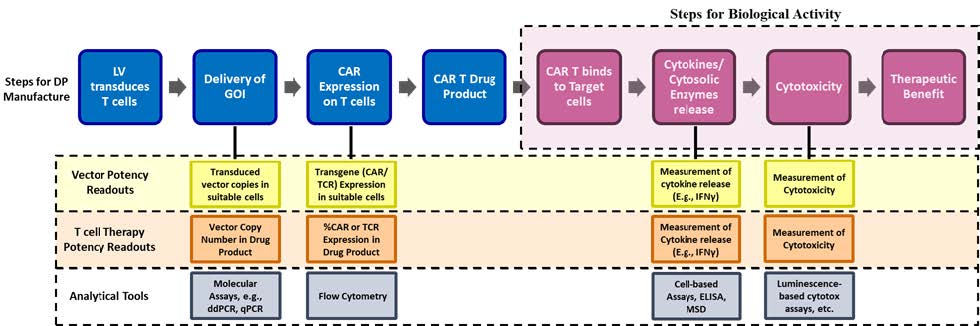
CAR and TCR T cell therapies affect target cells in an antigen-specific manner using multiple mechanisms, and therefore the use of orthogonal methods is recommended. A CAR or TCR T cell product is made by delivering the GOI using a suitable vector, e.g., a lentiviral vector (LVV). Upon GOI delivery, the engineered receptor is expressed on the T cells that can bind to specific antigens on target cells (e.g., cancerous cells). When the therapeutic cells interact with target cells via the engineered CAR or TCR, intracellular signaling cascades within the DP cells leads to the release of pro-inflammatory cytokines, cytolysis of the target cells, and expansion and proliferation of the engineered cells. These are key indicators of T cell activation. Thus, interferon gamma (IFNγ), a pro-inflammatory cytokine, serves as a critical downstream marker in this cascade, making it a relevant attribute for the MOA and quantifiable readout of CAR function4. 

When measuring potency for these complex therapeutics, a set of potency assays has been well validated for these applications (Figure 2). They include:

  1. Measuring the delivery and integration of GOI at genetic level: This can be done by using molecular techniques like ddPCR or qPCR.
  2. Measuring the expression of transduced GOI at a protein level: Transgene expression can be measured using flow cytometry to quantify the percentage of cells expressing the CAR.
  3. The biological activity of the GOI can be measured by quantifying cytokine release using cell-based assays such as ELISA, ELLA, MSD, or flow cytometry. 
  4. The biological activity of the GOI can also be measured by quantifying the killing of target cells using cell-based assays leveraging luminescence or flow cytometry.

Figure 2: A simplified overview of the gene-edited cell therapy manufacturing process and potency assay strategy based on key process steps.

In the example of a CAR or TCR T cell therapy, expression assays for the GOI are necessary for understanding potency for early-stage processes. Expression assays alone do not offer insight into the biological function of the cell product, however. This is where assays like those used for cytokine release or cytotoxicity are integral to a program and why at least one should be incorporated early, even if they are not used as qualified release assays at this nascent stage of development. These tests require more up-front work for method development — establishing acceptance criteria and creating controls and reference standards — but they can offer greater insight that is indispensable in the long term. 

Ideally, biological potency assays can be introduced early in development to gain product and assay knowledge critical to enabling the most appropriate methods and acceptance criteria for release and stability testing during pivotal clinical trials. Additionally, these assays are extremely useful to have in analytical comparability studies, including for changes introduced in early development. 

The vector potency determination also takes a similar approach of analytical readouts (Figure 2). During the initial phases of development for these therapies, the primary focus is on verifying the ability of the vector to successfully deliver the GOI into representative cells. This approach typically employs transduction of a target cell line by the vector. The transduced cells are cultured, harvested, followed by PCR amplification of the integrated provirus sequence, offering a precise measurement of the delivered gene copy. The functional vector potency readout is designed to demonstrate the ability of the vector to generate a biologically active CAR or TCR T cell based on readouts like cytokine release.

Key considerations during development of potency methods


Method development and optimization for these therapies require a systematic approach to ensure robust and reproducible processes that deliver high-quality therapeutic products. The molecular methods measuring drug product potency are based on accurate and precise quantification of cells with integrated vector based on a PCR-based readout. The development and qualification of a molecular assay are relatively straightforward and focus mainly on optimizing the primers, probe and PCR conditions, plus ensuring appropriate method controls. Similarly, the measurement of %CAR or %TCR -positive cells in DP using flow cytometry requires identification of appropriate antibodies and optimizing the staining conditions and gating strategy.

The biological potency for T cell product can be based on in vitro cell-based methods aimed at measuring cytokine release and/ or cell cytotoxicity. The method setup requires activation of T cell drug product by co-culture with antigen-presenting target cells or incubating with target antigen. Establishing the critical reagents, most importantly the target cell line or target antigen, is the first step to developing a robust method. Several pros and cons must be considered when finalizing the choice for the activation step as it must demonstrate consistent response in the potency readout. The target cell lines must be comprehensively tested to confirm cell viability, genetic stability, and expression of the specific antigen at appropriate levels. 

Optimization of the method variables such as cell seeding density, effector-to-target cell ratio during co-culture, duration of culture, etc., are equally critical to building a robust method. Part of the puzzle also requires identifying and optimizing a suitable analytical readout. For a cytokine release potency, the typical analytical tools include ELISA, ELLA, MSD, etc. The qualities influencing the choice of readout often include accuracy, precision, and robustness of the method, operator hands-on time, degree of automation, availability, and cost of suitable kits and reagents. 

The analytical tools and readouts used for vector potency measurement are similar to the T cell therapy product, but the key difference is the design, setup, and reportable results determining potency. A vector potency setup typically uses representative non-transduced cells, either derived from healthy donors or a suitable cell line, that are transduced in small-scale format by titrating vector test article. Upon completion of culture, the cells are harvested and tested to measure the transduction ability of the vector, plus downstream function, such as cytokine release, of the delivered GOI. 

Generating and characterizing cell banks is critical as it serves as a consistent and reliable starting material for transduction. Equally critical is bridging and demonstrating comparability of cell banks when needed for ensuring method consistency through the product’s lifecycle. To assess vector dose response, dose titration studies are conducted to correlate vector concentration with functional outcomes, such as transgene expression or biological activity4. Variables such as multiplicity of infection (MOI) range, transduction conditions such as exposure time, and media composition, are carefully evaluated to optimize gene transfer and maintain cell health. Post-transduction, harvest conditions, including timing and cell viability, must be standardized for a robust and consistent method performance. 

Summary

Overall, early development of robust potency strategies is crucial for ensuring the clinical and regulatory success of advanced therapies. By integrating phase-appropriate assays and continuously refining methods based on evolving understanding of mechanisms of action, developers can mitigate risks and improve product consistency. The establishment of reliable reference materials and the use of orthogonal testing approaches likewise provide critical insights into a product’s biological activity, facilitating smoother regulatory submissions. Ultimately, a well-defined potency strategy supports the timely delivery of quality, safe, and effective therapies while minimizing setbacks and aligning with regulatory expectations. 

Many sponsors face challenges developing a potency control strategy specifically for cell and gene therapies due to the complexities in understanding and measuring the biological effect of the products. Additionally, smaller, younger companies may not have the required resources and expertise, or a larger organization may be working on more traditional modalities and not have the CGT experience. With extensive experience across a range of modalities—including genetically modified cell therapies, gene editing, and viral and non-viral vectors—ElevateBio ensures that potency assays evolve appropriately throughout the development lifecycle, from preclinical stages to first-in-human trials and beyond, supporting critical milestones toward commercial filing. This phase-appropriate, data-driven approach enables companies to meet regulatory requirements while optimizing the consistency, safety, and efficacy of their therapies.

References: 

  1. U.S. Food and Drug Administration. (2023). Potency Assurance for Cellular and Gene Therapy Products: Draft Guidance for Industry. Retrieved from https://www.fda.gov/regulatory-information/search-fda-guidance-documents/potency-assurance-cellular-and-gene-therapy-products
  2. European Medicines Agency. (2023). Guideline on quality, non-clinical and clinical aspects of medicinal products containing genetically modified cells (Revision 1). Retrieved from https://www.ema.europa.eu/en/documents/scientific-guideline/guideline-quality-non-clinical-and-clinical-aspects-medicinal-products-containing-genetically-modified-cells-revision-1_en.pdf
  3. U.S. Food and Drug Administration. (2011). Guidance for Industry: Potency Tests for Cellular and Gene Therapy Products. Retrieved from https://www.fda.gov/files/vaccines,%20blood%20%26%20biologics/published/Final-Guidance-for-Industry–Potency-Tests-for-Cellular-and-Gene-Therapy-Products.pdf.
  4. Kiesgen S, Messinger JC, Chintala NK, Tano Z, Adusumilli PS. Comparative analysis of assays to measure CAR T-cell-mediated cytotoxicity. Nat Protoc. 2021 Mar;16(3):1331-1342. doi: 10.1038/s41596-020-00467-0. Epub 2021 Feb 15. PMID: 33589826; PMCID: PMC8064272.

Footer

ElevateBio

Investors & Media

LinkedIn Twitter

© 2026 ElevateBio. All Rights Reserved.

Privacy & Cookie Policy

  • Manufacturing & Discovery Services
  • Technologies
  • Advanced Therapies
  • Partner With Us
  • About
  • Presentations & Publications
  • Elevated Insights
  • Careers
  • Facilities
  • Contact
MENU
  • Manufacturing & Discovery Services
    • Manufacturing & Discovery Services Overview
    • Gene Editing Design & Optimization
    • Process Development
    • Analytical Development
    • cGMP Manufacturing
    • Next-Generation Sequencing
    • Quality
    • Regulatory CMC
    • Certifications & Compliance
    • Generative AI
  • Technologies
    • Technologies Overview
    • Gene Editing
    • Viral and Non-Viral Delivery
    • Messenger RNA (mRNA)
    • Induced Pluripotent Stem Cells (iPSCs)
  • Advanced Therapies
  • Partner With Us
  • About
    • About Overview
    • Our Journey
    • Our Team
    • Culture of Expedition
    • Careers
  • Media
    • Investors & Media Overview
    • Press Releases
    • Presentations & Publications
    • Elevated Insights
  • Careers
  • Facilities
  • Contact