Large Serine Recombinases for Targeted Gene Insertion
A targeted gene insertion platform combining a diverse LSR collection, protein engineering, and multiple insertion approaches.
Large gene insertion can expand what genomic medicines are designed to do. No single insertion system, however, fits every cargo, target, cell type, or delivery route.
ElevateBio has developed a broad LSR-based platform to give programs more options for targeted large gene insertion.
// Large Serine Recombinases for Targeted Gene Insertion
100+ Active LSRs identified
>25% CAR insertion with novel LSRs in primary T cells before engineering
>90% TCR knockout via LSR landing-pad insertion at TRAC
>50% Targeted CAR insertion at TRAC across multiple donors, up to 67%
BREADTH
No Single LSR Fits Every Target
Most LSR work has centered on a handful of well-characterized enzymes, including Bxb1. Each has a distinct integration profile, making different LSRs better suited to different applications. Relying on a single LSR means the program must work within that enzyme’s constraints.
ElevateBio built a broader starting set:
30,000+ LSR candidates mined
100+ active LSRs identified through experimental screening
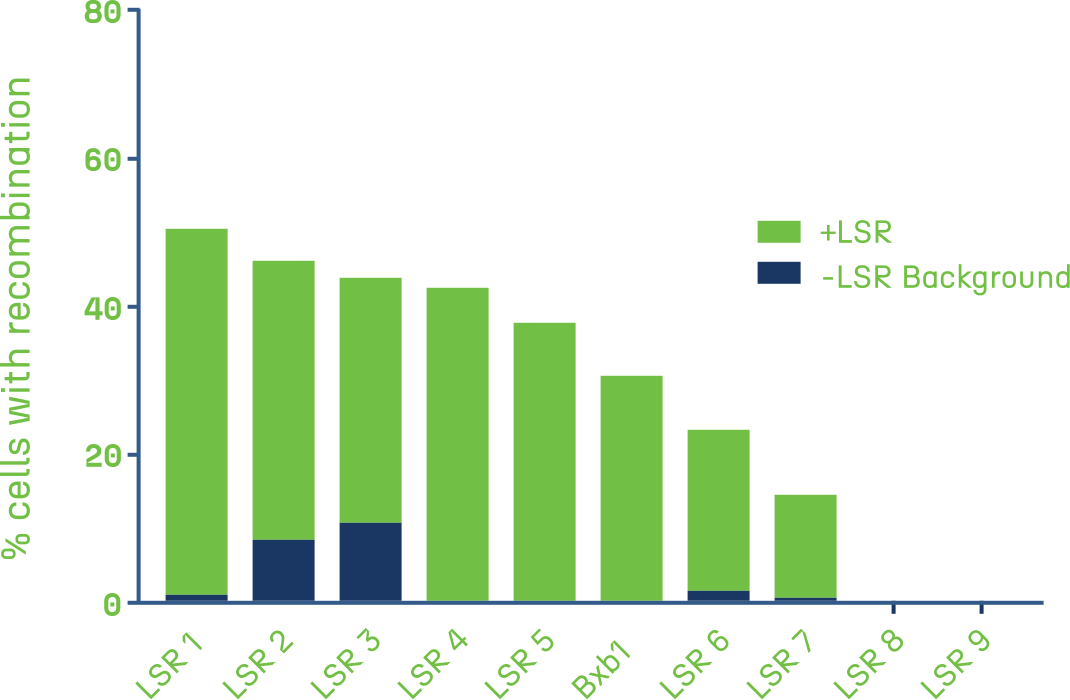
Multiple LSRs outperforming Bxb1 in mammalian-cell assays
Cognate attB/attP sites mined and predicted with candidate LSRs
More enzyme diversity creates more opportunities to identify a useful starting point for a therapeutic program.
Representative mammalian-cell activity across 9 novel LSRs
Next-Generation Enzymes for Targeted Gene Insertion
David Wiley, PhD | ASGCT 2026
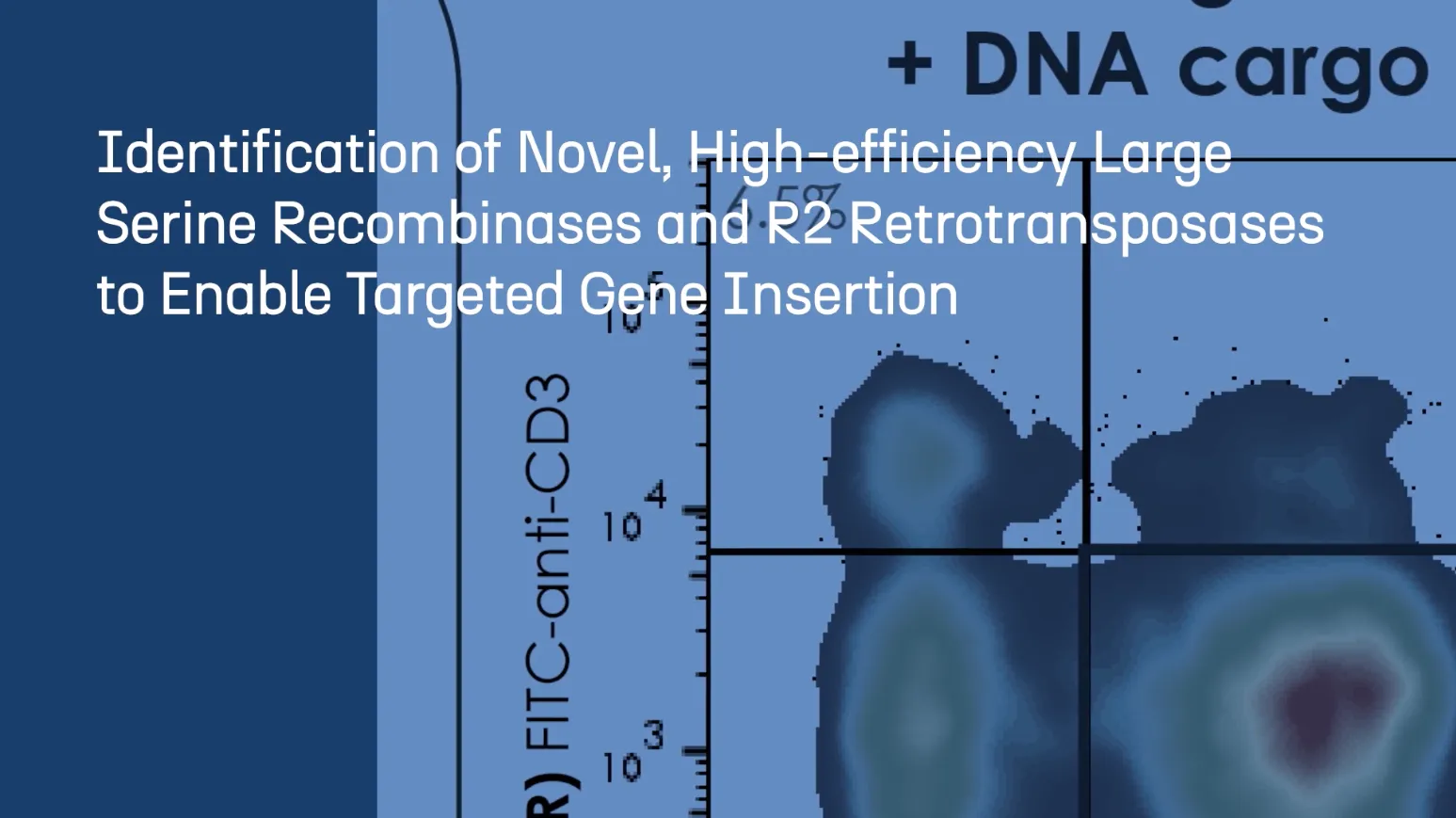
More than 100 active LSRs identified, with novel ElevateBio LSRs demonstrating activity in primary human T cells.
A promising LSR is a starting point. Wildtype activity may still fall short of what a therapeutic application requires.
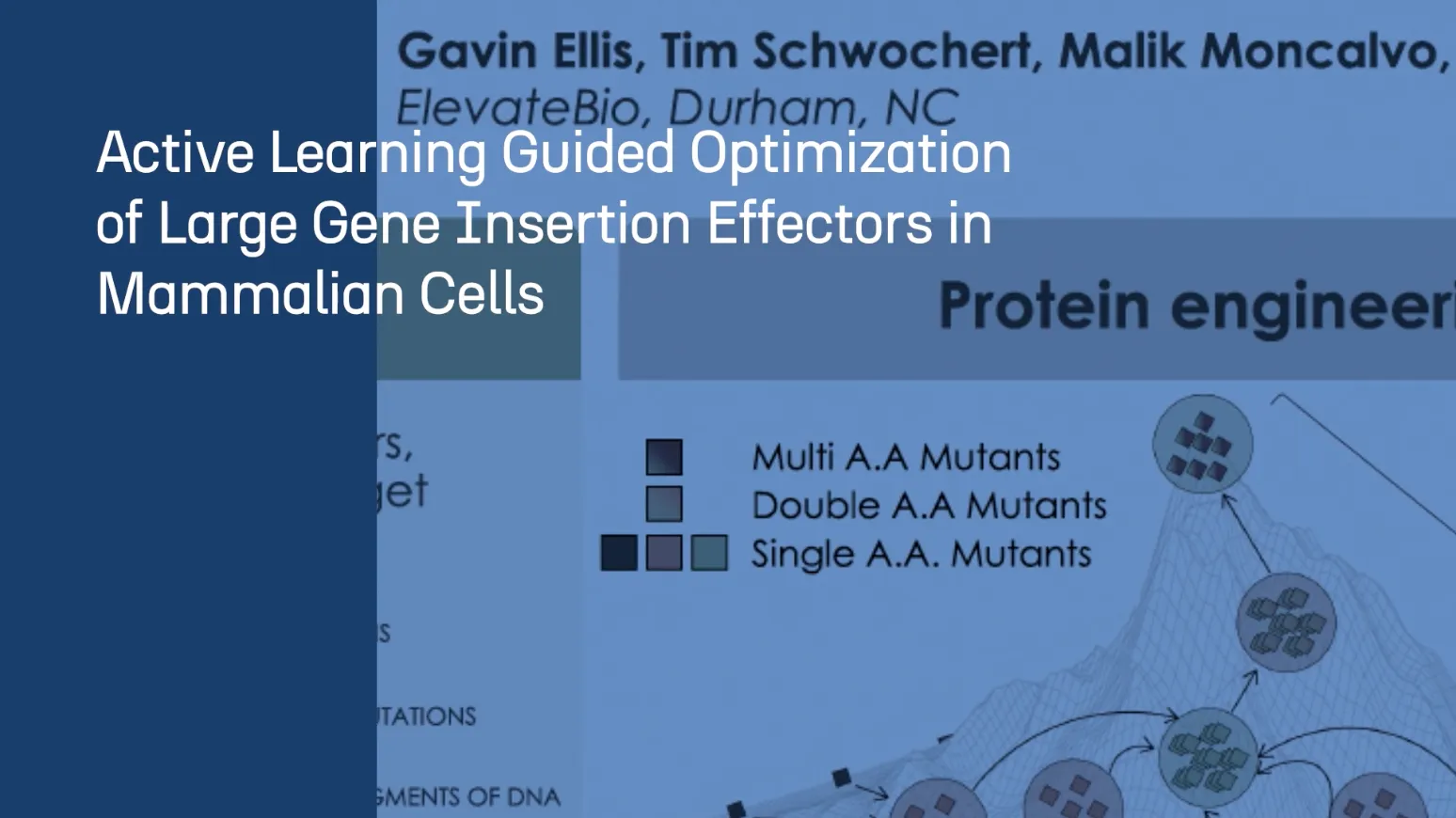
ElevateBio combines mammalian-cell testing, automation, protein language models, and active learning to improve performance. In the disclosed study, two rounds of engineering took about four weeks and identified higher-activity variants.
~4 weeks
Two optimization rounds
Up to 2.4×
Single-mutant activity
Up to 3.4×
Double-mutant activity
Current disclosed data demonstrate LSR activity optimization; engineering new target-site specificity remains in development.
Active-Learning-Guided Optimization of Large Gene Insertion Effectors in Mammalian Cells
Gavin Ellis, PhD | ASGCT 2026
Active-learning-guided engineering rapidly improved the activity of a selected LSR in a mammalian-cell assay.
A diverse LSR collection creates more insertion options. Some programs, however, require insertion at a preselected genomic locus. For those applications, ElevateBio has demonstrated a different ex vivo path: install a landing pad at the selected locus, then insert the cargo with an LSR.
TRAC | Primary Human T Cells
90% TCR knockout
via landing-pad insertion
50% targeted CD19 CAR insertion
at TRAC across multiple donors
Up to 67% targeted CD19 CAR insertion
in the highest-performing donor
INSERTION APPROACHES
Two LSR Paths Today
DIRECT LSR
Starts with: LSR integration profile
Identify an LSR with a useful integration profile
Evidence: >25% CAR insertion in primary T cells without potency engineering
Best fit today: Programs compatible with an existing LSR profile
LANDING PAD + LSR
Starts with: Preselected genomic locus
Install an attachment site, then insert cargo
Evidence: >90% TCR knockout via landing-pad insertion at TRAC; >50% targeted CD19 CAR insertion across multiple donors
Best fit today:Ex vivo programs requiring a preselected locus.
DELIVERY
The Right Enzyme Still Has to Get Into the Cell
A potent LSR and the right insertion approach only matter if the components reach the cell. Large DNA payloads remain especially difficult to deliver efficiently into primary T cells.
In a separate study from the TRAC landing-pad workflow:
<20%
CD19-CAR-positive cells Electroporation
vs.
Up to ~88%
CD19-CAR-positive cells LNP delivery
Important: These delivery data come from a separate experiment and should not be combined with the TRAC landing-pad results.
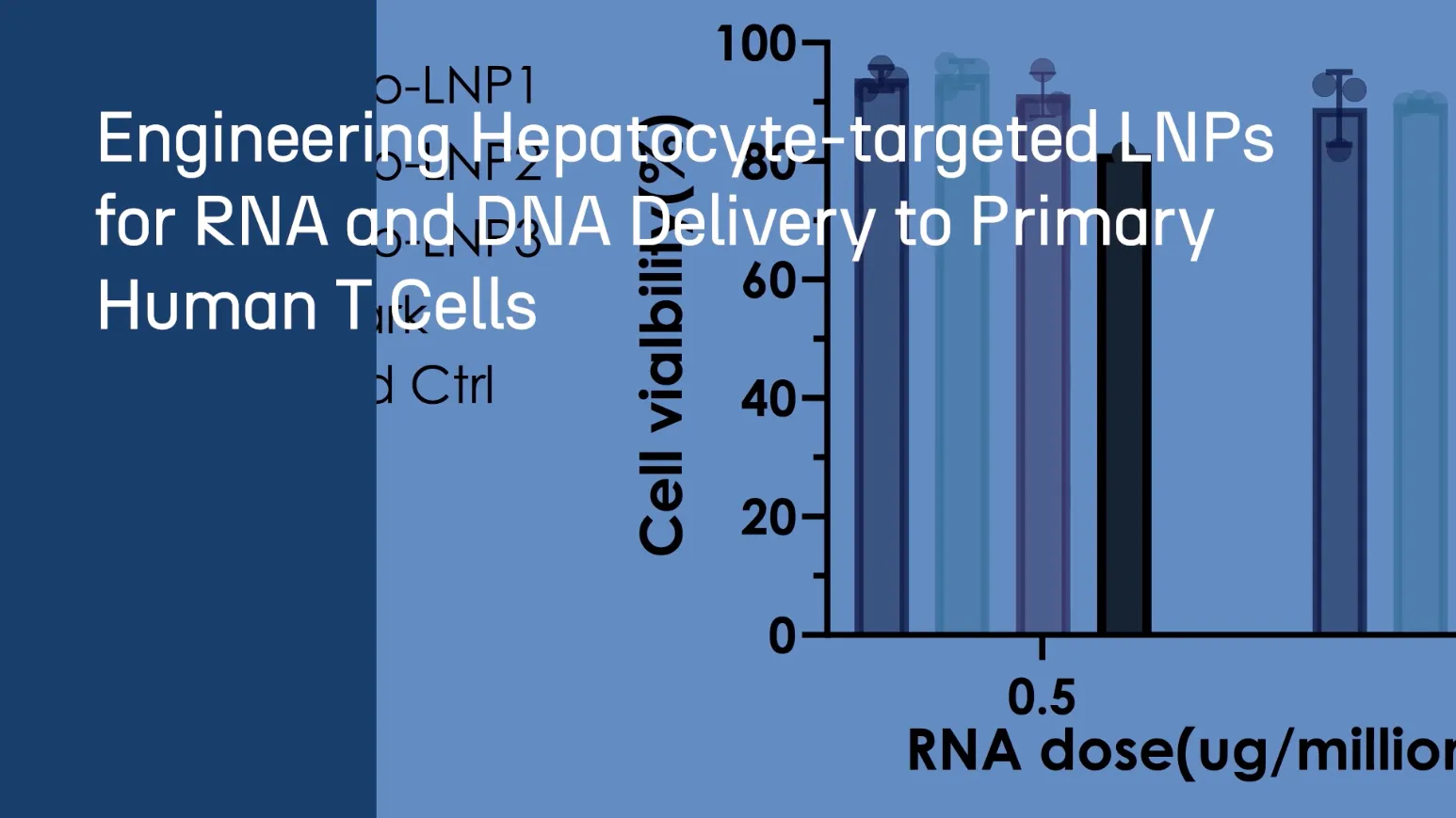
ElevateBio is developing LNP approaches to expand the options for non-viral large-cargo delivery.
Engineering Hepatocyte-Targeted LNPs for RNA and DNA Delivery to Primary Human T Cells
A large serine recombinase (LSR) recognizes matched DNA attachment sites and recombines donor DNA into the genome. Unlike nuclease-based insertion approaches, the LSR reaction does not create exposed double-strand breaks during insertion. ElevateBio has identified and characterized more than 100 active LSRs for targeted large gene insertion.
Not always. Direct LSRs can insert at naturally occurring genomic pseudo-sites that resemble an LSR’s cognate attachment sequence. When a program requires insertion at a preselected genomic locus, ElevateBio has separately demonstrated a landing-pad approach in which an attachment site is first installed at the target locus and then used for LSR-mediated cargo insertion. At TRAC in primary human T cells, this workflow achieved >90% TCR knockout via landing-pad insertion and >50% targeted CAR insertion across multiple donors, with insertion reaching up to 67%.
ElevateBio demonstrated greater than 50% targeted CD19 CAR insertion across multiple primary T-cell donors, with insertion reaching 67% in the highest-performing donor. The workflow used a landing pad installed at TRAC followed by LSR-mediated cargo insertion.
ElevateBio has demonstrated insertion of a 4.6 kb+ CD19-CAR DNA payload in primary human T cells using novel LSRs. ElevateBio has not disclosed the maximum payload size validated experimentally.
Different LSRs have different attachment-site preferences, activity levels, and genomic integration profiles. ElevateBio identified more than 30,000 LSR candidates and has experimentally identified more than 100 active LSRs, with several outperforming the literature benchmark Bxb1 in mammalian-cell assays. ElevateBio’s discovery pipeline also predicts the cognate attB and attP sites associated with candidate LSRs, providing the components needed for functional testing. A larger, more diverse collection increases the opportunity to identify a useful starting point for a therapeutic program.
They are two separate studies. The landing-pad study installed an attachment site at TRAC and then used LSR-mediated insertion, achieving greater than 50% targeted CD19 CAR insertion across donors and up to 67%. In a separate delivery study, ElevateBio compared electroporation with LNP delivery of LSR mRNA and CAR donor DNA. That study measured less than 20% CD19-CAR-positive cells with electroporation versus up to approximately 88% with LNP delivery. The LNP and TRAC landing-pad workflows have not been demonstrated together in the disclosed data.
In ElevateBio’s disclosed active-learning study, protein engineering produced a single-mutant LSR with up to 2.4-fold greater activity than wildtype and a double-mutant with up to 3.4-fold greater activity. These are improvements in measured LSR activity in the experimental system, not demonstrated changes in clinical dose, efficacy, or safety.
Not in the disclosed data presented here. ElevateBio’s published LSR insertion results are from in vitro mammalian-cell studies, including primary human T cells. The chosen-locus landing-pad workflow is currently positioned for ex vivo applications.
Working with ElevateBio
Bring Us Your Insertion Problem
Start with the biology. Then determine which path is worth pursuing.
01
Define the challenge
Locus, cargo, cell type, delivery route
02
Select the approach
Direct LSR or landing-pad approach
03
Establish proof of concept
Test insertion in the relevant cellular context
04
Optimize where needed
Improve activity and characterize specificity
05
Advance the program
Expand optimization, characterization, and development